

Epoxy Flooring · Tampa Bay Homeowner Guide
Epoxy Flooring in Tampa: What Florida's Climate Actually Requires
By Performance Floors & Coating · Tampa, Florida · Updated March 2026 · 8 min read
If you've ever watched a freshly-coated garage floor peel, yellow, or bubble in Tampa, you weren't imagining things — and it wasn't a fluke. Florida imposes a set of environmental demands on epoxy flooring that most national content completely ignores. The same coating system that performs well in Denver or Chicago can fail within two years in Tampa Bay, not because the product is bad, but because it was designed for a fundamentally different climate.
This guide covers what actually matters for Tampa homeowners shopping for garage floor coatings — UV exposure, ambient humidity, salt air, and Florida's year-round heat cycling. We'll explain why the coating system matters more than the brand name, and what questions to ask any epoxy flooring company in Tampa before you commit.
Why Tampa's Environment Is Harder on Coatings Than Almost Anywhere Else
Tampa sits in USDA Hardiness Zone 10a, which means near-year-round heat, intense UV radiation, and average relative humidity regularly above 75%. Those three factors combine to create a coating environment that punishes installation shortcuts and material compromises far faster than cooler, drier climates.
UV Radiation
Florida consistently ranks among the highest states for UV Index exposure, according to data from the U.S. Environmental Protection Agency's UV Index program. Garage floors with south- or west-facing doors receive direct sunlight during peak UV hours for hours each day. Standard aromatic epoxy coatings — the most common and least expensive formulation — begin to yellow and chalk under UV exposure within 12–18 months. This isn't cosmetic; UV degradation breaks down the cross-linked polymer structure, reducing both bond strength and surface hardness over time.
Humidity and Moisture Vapor
Tampa's high ambient humidity creates a chronic moisture vapor transmission (MVT) challenge that concrete slab owners in drier climates rarely face. The ASTM F1869 standard for moisture vapor emission testing was developed specifically because high-MVT slabs cause coatings to delaminate from below — a failure mode where the coating looks intact from above but has lost adhesion to the concrete underneath. Florida slabs routinely test above the 3 lb/1,000 sq ft/24 hr threshold that triggers this risk, particularly near Tampa Bay, Old Tampa Bay, or the Gulf Coast. A 100% solids Moisture Vapor Barrier (MVB) epoxy base coat — rated to handle up to 15 lbs of vapor transmission — is the correct foundation for these conditions, not a standard epoxy primer.
Salt Air
For homeowners in coastal neighborhoods — from St. Pete Beach through Clearwater Beach to Safety Harbor and the bay-adjacent areas of South Tampa — airborne chloride deposition is an additional stressor. AMPP (formerly NACE International), the global authority on corrosion science, documents that chloride ions accelerate both concrete carbonation and coating bond degradation. This is why the same epoxy floor coating system that holds up fine in Orlando may perform noticeably worse in a garage two blocks from Tampa Bay without a chloride-tolerant primer.
Florida building codes require concrete slabs to cure for a minimum of 28 days before coating application, but in Tampa's conditions, many slabs retain elevated moisture content well beyond that window — especially in newer construction where ground moisture hasn't stabilized. A reputable installer will test before they quote, not after they've committed to a price.
Matching the Coating System to Florida's Conditions
Standard Epoxy — What Works and What Doesn't
Aromatic epoxy (the most common type) has one well-documented limitation in Florida: UV yellowing. This is chemistry, not opinion — aromatic amine hardeners break down under UV exposure in a process called photodegradation. If your garage door is open regularly or sunlight reaches the floor, an aromatic epoxy topcoat will begin to yellow within the first Tampa summer. For purely indoor applications — workshops, interiors, commercial spaces away from sunlight — epoxy remains a cost-effective and durable choice. For garages with any sun exposure, it needs a UV-stable topcoat or a different chemistry altogether.
The second epoxy challenge in Florida is application temperature. Epoxy requires ambient temperatures between roughly 50°F and 85°F for proper cure — a window that is far narrower in Tampa's climate than manufacturers' national marketing suggests. Mid-summer installation of epoxy in an un-airconditioned garage can result in flash-curing and an uneven finish. The practical installation window for epoxy in Tampa is primarily October through April.
Polyaspartic Epoxy Floor Coatings — Built for Florida
Aliphatic polyaspartic coatings represent the current standard for high-performance epoxy floor coatings in Tampa Bay conditions. Unlike aromatic epoxy, aliphatic polyaspartic uses a chemical structure that doesn't degrade under UV — it's the same class of chemistry used in automotive clear coats and marine deck coatings, which are designed to hold up under sustained Florida sun. According to peer-reviewed research published in Progress in Organic Coatings, aliphatic polyurea and polyaspartic coatings demonstrate significantly superior UV resistance compared to aromatic systems across equivalent exposure periods.
Polyaspartic also cures in 1–4 hours, which means it can be installed year-round in Florida regardless of ambient temperature, and your garage is back in service the same day. For homeowners who can't have their garage out of commission for a week during epoxy cure time, this is a meaningful practical advantage.
The System We Install: MVB Epoxy Base + Polyaspartic Topcoat
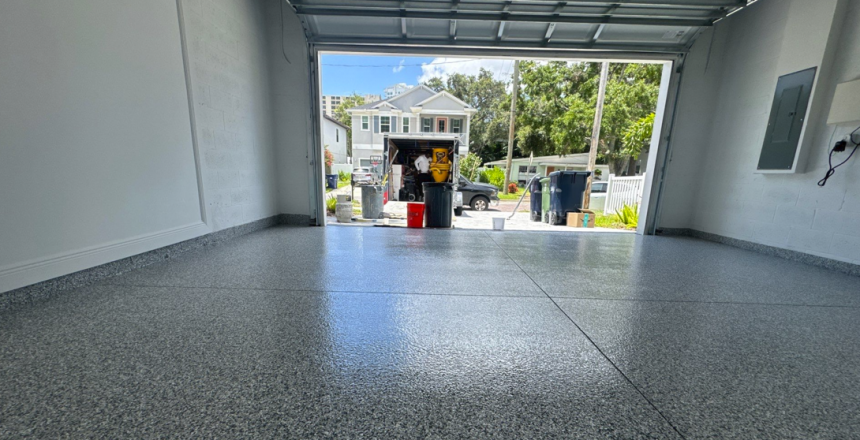
Performance Floors & Coating installs a multi-layer system on Tampa Bay garage floors built specifically for Florida slab conditions. The foundation is a 100% solids Moisture Vapor Barrier (MVB) epoxy base coat — engineered to withstand up to 15 lbs of vapor transmission, which is well above the threshold that causes standard coatings to fail on Florida slabs. A polymer flake broadcast layer is applied over the base coat for color and texture, finished with an aliphatic polyaspartic topcoat for UV stability and long-term surface durability. In certain commercial or high-demand settings where additional flexibility is warranted, polyurea is incorporated into the system as applicable. Our crews are Simiron Certified installers — a manufacturer-backed credential that means every product, mix ratio, and application technique has been trained and verified to spec. This is not a standard epoxy kit — it's a coating stack engineered for what Florida concrete actually faces, not what a national sales brochure describes.
Coating System Comparison for Tampa Bay Conditions
| Factor | DIY Epoxy Kit | Standard Pro Epoxy | MVB Epoxy + Polyaspartic System |
|---|---|---|---|
| Florida UV resistance | Poor — yellows fast | Poor without aliphatic topcoat | Excellent — aliphatic chemistry |
| Humidity / MVT tolerance | Very low — bubbles on FL slabs | Moderate with MVT primer | High — moisture-tolerant base coat |
| Salt air / coastal durability | Poor | Moderate | Excellent |
| Year-round FL install window | Limited — heat affects cure | Oct–Apr recommended | Year-round |
| Return to vehicle traffic | 5–7 days | 5–7 days | Same day (3–4 hrs) |
| Lifespan (Tampa conditions) | 1–3 years typical | 3–7 years with maintenance | 10+ years / lifetime warranty |
| Typical installed cost (2-car garage) | $200–$500 materials | $1,800–$2,800 | $2,500–$4,000 — see our garage floor coatings page |
5 Questions to Ask Any Epoxy Flooring Company in Tampa Before You Hire
The Tampa Bay metro has no shortage of concrete coating contractors. Some are excellent. Others are storm-chasing crews that move market to market and won't be around to honor a warranty. Before you sign anything, ask these five questions — and if you want to know more about who we are before you call, our About Us page covers our background, certifications, and what sets us apart.
- Do you test for moisture vapor emission before quoting? — Florida slab MVT varies dramatically by location, age, and proximity to water. An installer who doesn't test is guessing, and the homeowner pays when it fails. The ASTM F1869 calcium chloride test or F2170 in-situ RH probe takes under an hour and should be standard practice.
- Is your topcoat aliphatic or aromatic? — Aromatic topcoats will yellow. If a contractor can't tell you which chemistry they're using, they likely don't know — and that matters in Florida. Ask for the product data sheet.
- What surface prep method do you use? — Diamond grinding is the standard for MVB epoxy and polyaspartic adhesion per ICRI guidelines. Acid washing alone does not achieve the concrete surface profile required for a proper bond. Any contractor who acid-washes and moves on is taking a shortcut that will show up at year two.
- Are you licensed and insured in Florida? — Florida requires contractor licensing through the Florida Department of Business and Professional Regulation (DBPR). Verify their license number before anyone steps on your property.
- Is your warranty transferable? — Tampa's real estate market is active. A transferable lifetime warranty is a selling point when you list — and it signals that the contractor stands behind their work beyond the initial transaction.
When you search "epoxy flooring Tampa," some of the top Google Business Profile results are name-stuffed listings — businesses whose GBP name contains the keyword phrase but who may not be locally established operations. Before hiring based on search rank alone, check how many Google reviews they have, how long they've been operating, and whether they have a verifiable Florida contractor license number.
Where We Install Across Tampa Bay
Performance Floors & Coating serves homeowners and businesses throughout the Tampa Bay area, on both sides of the bay. We install in Tampa, St. Petersburg, Clearwater, Brandon, Riverview, Wesley Chapel, Palm Harbor, Sarasota, and throughout the greater metro. If you're not sure whether we cover your neighborhood, reach out and ask — our crews cover a wide footprint across Hillsborough, Pinellas, and Pasco counties.
Our Clearwater, St. Pete, and coastal Pinellas crews understand the additional salt air and humidity demands that come with proximity to the Gulf and Tampa Bay. We use chloride-tolerant primers on coastal installations as a standard practice — not an upcharge. If you've had a previous coating fail near the water, there's a good chance the installer skipped this step.
The Bottom Line for Tampa Homeowners
Standard epoxy flooring isn't a bad product — it's the wrong product for a Florida garage with sun exposure, high humidity, or coastal proximity. A professional MVB epoxy base coat topped with an aliphatic polyaspartic finish addresses every failure mode that Tampa's climate creates: moisture vapor, UV degradation, salt air, and summer heat. The cost premium over a basic epoxy installation is real, but so is the difference in what you're still looking at in year five.
If you're comparing garage floor coating companies in Tampa, we'd encourage you to get at least two quotes — and to ask the five questions above. The cheapest bid usually skips the moisture test, uses aromatic chemistry, and won't be answering the phone when the coating starts to peel.
Performance Floors & Coating has completed thousands of Florida garage floors and carries a 5.0-star rating across 703+ verified Google reviews. We back our work with a lifetime warranty. Get a free, no-obligation estimate — we'll include a moisture test on the house.
Tampa's Most Reviewed Garage Floor Coating Company
Free estimates · Same-day cure · Lifetime warranty · Serving Tampa, St. Pete, Clearwater & all of Tampa Bay
Get Your Free Estimate