What Does a
Floor Coating
Actually Cost?
Good question — and honestly, we wish we could just give you a number. But if a contractor posts a flat price online without seeing your slab, they're either guessing or lowballing you to get the call. Here's what actually goes into it.
Every Floor Is Different.
Every Price Should Be Too.
We get asked about pricing constantly — and we genuinely wish we could just hand you a number. The honest reason we don't: a price posted online is either too low to be real, or padded high enough to cover every possible situation. Neither one actually helps you.
Florida concrete has its own set of challenges — high water tables, sandy soil that shifts, UV that destroys the wrong coatings fast. Two slabs on the same street can need completely different prep. The only price that means anything is one that comes from someone standing on your actual floor. That visit is free, takes about 30–45 minutes, and the price we give you holds for a full year.
We've tried doing it the other way — giving people ballpark numbers over the phone. It always led to surprises on install day, for them and for us. Now we just come see it. Thirty minutes, no pressure, and you get a real number you can actually plan around.Performance Floors & Coating — Tampa, FL
What Are We Coating?
Pick your surface below. Each one has its own set of things we look at during a free visit — especially here in Tampa, where the climate throws things at concrete that most of the country never deals with.
Garage Floor Coating
Tampa garages take a beating — oil, salt air off the Gulf, and concrete that's been baking under the Florida sun for years. Before we recommend anything, we look at six things. Miss any one of them and you're looking at a peeling floor inside of two years.
Tampa's high water table means many slabs test positive for moisture vapor. When levels call for it, we apply a moisture vapor barrier before coating — skipping this step is one of the main reasons coatings fail prematurely in Florida.
Measured precisely on-site — 1-car, 2-car, and tandem garages vary and affect materials and labor.
Cracks, pitting, oil staining, old epoxy, and spalling all need individual attention before coating.
Failed DIY epoxy kits are the most common removal job we see in Tampa. Removal time and difficulty affects scope significantly.
Standard flake broadcast, custom blends, metallic finishes, and multi-zone designs all have different material and application requirements.
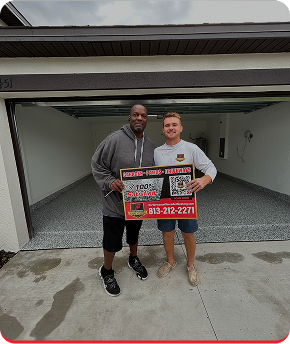
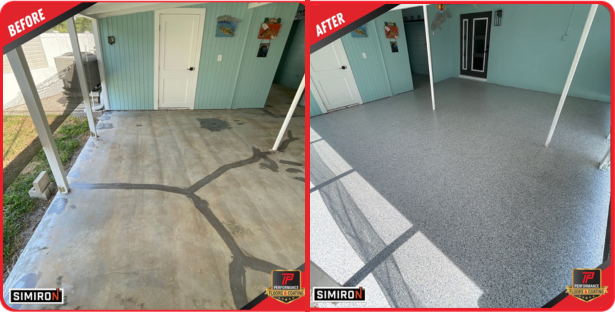
Patio & Lanai Coating
A screened lanai in Lutz and an open patio in South Tampa are two completely different jobs. The sun exposure, humidity, drainage, and how the slab breathes all change what we put on it. Here's what we look at.
Open patios need a higher-spec UV-stable topcoat than shaded lanais. Exposure angle and cover affect product selection.
Screened lanais trap humidity differently than open patios — ventilation profile affects the moisture approach.
Columns, drains, and step edges all affect prep time and material calculations.
Poor drainage around lanai slabs accelerates moisture vapor issues. We assess drainage before recommending anything.
Color coordination with the home exterior, flake density, and gloss level all factor in.
Pool Deck Coating
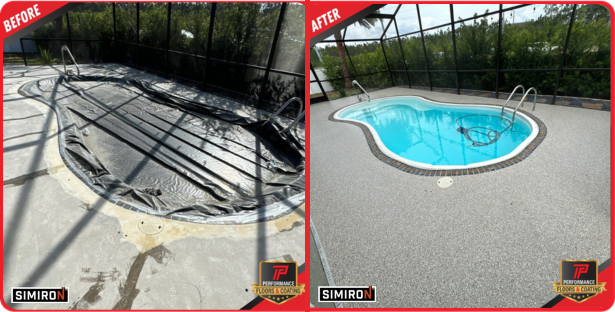
Pool decks are probably the hardest surface we coat. Chlorine, constant moisture, barefoot traffic, and full Florida sun all day long. The wrong product here doesn't just look bad — it gets slippery, fades, and starts lifting at the edges. Here's exactly what we check.
Chlorine, salt systems, and algaecides require a specifically formulated chemical-resistant topcoat.
Pool decks at the edge often need a waterproof, crack-bridging system — more involved than a standard coating.
Dark coatings on Tampa pool decks can exceed 140°F underfoot. Cool-to-touch options are assessed based on exposure.
Tight angles at the coping edge, expansion joints, and drain locations add to prep complexity.
Pool decks are often the most cracked surfaces we work on. Crack repair scope is assessed individually.
Driveway Coating
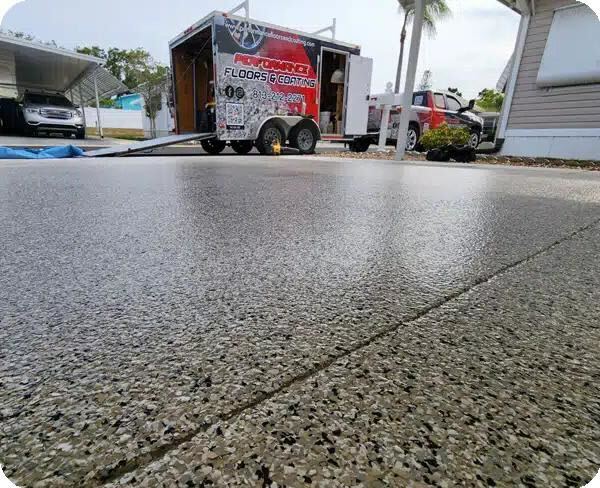
Driveways sit in full sun all day and deal with vehicle weight, oil drips, and heat that can push past 140°F on the surface. A lot of driveways we see in Tampa have serious cracking that needs to be dealt with before anything goes on top. Here's the rundown.
Heavy trucks or multiple daily vehicles require a higher-build system than a light-use residential driveway.
Curved driveways, aprons, and turnarounds are all measured and assessed as part of the project scope.
Driveways typically have the most extensive cracking we see. Expansion joints and surface spalling are each addressed individually.
Full-exposure driveways in Tampa need a UV-resistant polyaspartic topcoat that can hold up to constant sun and surface temperatures that regularly exceed 140°F.
Measured precisely on-site including aprons and transition zones.
Porch & Entryway Coating
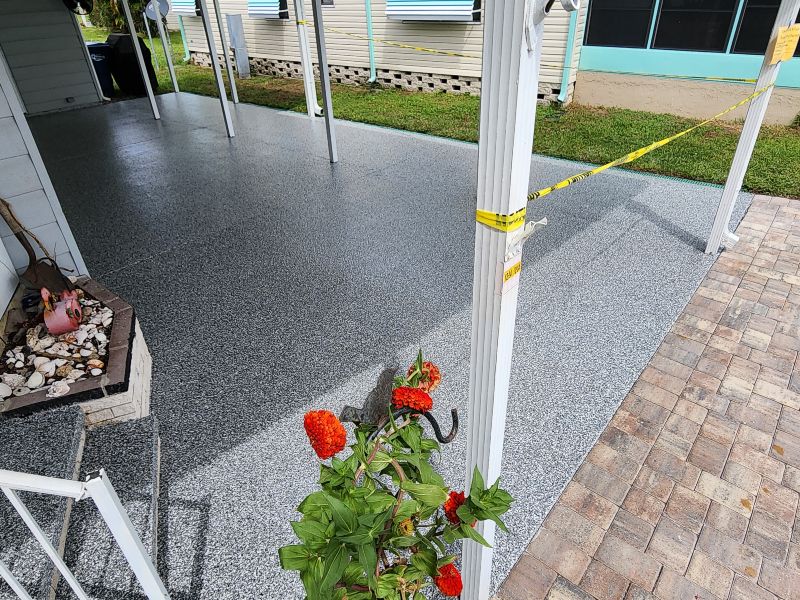
Small square footage, but it's the first thing everyone sees. We treat a porch the same way we treat a garage — same prep standards, same coating quality. And if you're doing the driveway or garage too, bundling them usually makes sense for everyone.
Smaller projects have minimum job requirements — we'll advise whether bundling with an adjacent surface makes sense.
Covered porches vs. fully exposed entries require different UV-resistance specs in the topcoat.
Entry slabs with existing sealers, staining, or damage require mechanical prep before coating.
Often coordinated with the home's exterior, garage floor, or driveway for a cohesive look.
Commercial & Industrial Coatings
Commercial jobs vary more than almost anything else we do — a restaurant kitchen, an auto shop, and a warehouse all need completely different systems. Downtime matters, traffic matters, and chemical resistance matters. We get into all of it before recommending anything.
Foot traffic, forklift traffic, and heavy vehicle use each require different build thicknesses and hardness specs.
Auto shops, restaurants, and warehouses all have specific chemical resistance requirements.
Fast-cure polyaspartic systems allow return-to-service in hours — critical for active facilities.
Large commercial floors typically qualify for volume pricing. Complex layouts assessed individually.
Safety lanes, equipment zones, and floor striping quoted as add-ons during the on-site assessment.
Diamond Grinding Is Advertised
By Almost Everyone. Few Do It Right.
"Diamond grinding" has become a selling point in this industry — and it should be. But just knowing a grinder was used doesn't tell you much. What matters is the surface profile it actually left behind. That's where a lot of quotes fall apart.
The CSP Scale — and Why CSP-3 Is the Minimum
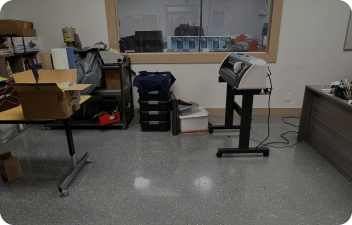
The concrete industry uses a standardized Concrete Surface Profile (CSP) scale to define what "prepared" actually means. It runs from CSP-1 — barely touched — to CSP-10, a full shot blast. The coating manufacturer's data sheet tells you what profile their product needs to bond correctly. For professional polyurea and polyaspartic systems, that floor is CSP-3.
A lot of crews run one pass with a light grinder and move on. That gets you to CSP-1 or maybe CSP-2 — it looks done, it'll show up fine in a photo, and it'll start peeling within a year or two. Our crews are trained to know what a properly profiled slab looks like and feels like — and we keep grinding until we get there. No shortcuts on prep, because that's where the job is actually won or lost.
"We diamond grind every floor." Nearly every competitor says it. Almost none mention CSP rating, number of passes, grit sequence, or how they verify the result.
We hit CSP-3 or better on every job using industrial planetary grinders. Our crews are trained to know what proper profile looks and feels like — and we keep grinding until we're confident the surface is ready to coat.
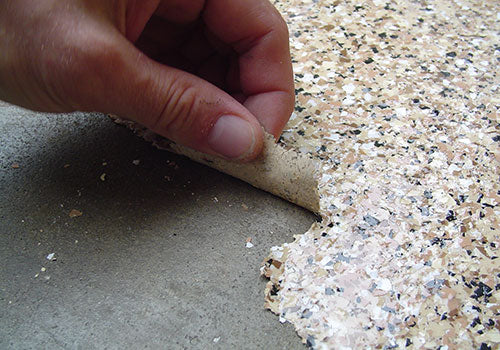
The coating grabs the surface layer, not the concrete itself. Florida's heat, moisture, and traffic do the rest — usually delamination within the first year.
At CSP-3, the concrete is genuinely open. The coating flows into peaks and valleys and locks in. That's the bond that holds up to Tampa summers and years of use.
A contractor who can't answer these specifically may not be using a professional-grade process — regardless of what their marketing says.
The Factors Behind
Every Honest Quote
These are the variables every specialist evaluates during a free on-site visit. Click any card to learn why it matters — especially in Tampa's specific climate.
Click any card to expand
Total coated area is measured precisely on-site — not estimated from a floor plan. Larger projects reduce the effective cost per square foot because mobilization, equipment setup, and material delivery costs spread across more surface area. Always measured during the free visit.
More sq ft = lower per-sq-ft costTampa's water table is legitimately one of the highest in Florida — and a good number of slabs here test positive for moisture vapor. When the moisture reading calls for it, we apply a moisture vapor barrier before coating. Without it, trapped moisture pushes the coating up from underneath, usually within months. We test every slab and make that call based on what we find, not as a standard add-on.
Applied when moisture levels require itSandy soil, tree roots, and the wet-dry season Florida gets every year — most slabs have at least some cracking, and that's okay. Hairline cracks get handled in standard prep. Bigger ones get routed and filled with flexible filler before we grind. We look at every one individually, not as a line item to rush past.
Assessed on every single jobOld paint, sealers, and failed DIY epoxy kits all have to come off before a new coating can bond. The box-store epoxy kits are the worst — they're thin, they didn't bond right to begin with, and grinding them off takes real time. We assess how much is there and how stuck it is before we quote anything.
Most common add-on we see in TampaInterior garages and shaded lanais use a different system than fully exposed pool decks and driveways. Florida's UV index is among the highest in the continental US — outdoor surfaces need a UV-resistant polyaspartic topcoat to hold up against the sun over time. Not all topcoats are formulated for full outdoor exposure in a climate like Tampa's.
Critical in Tampa's UV environmentStandard full-flake broadcast is our most popular and cost-effective option — over 40 color combinations available. Custom multi-blend colors, metallic systems, decorative borders, and multiple finish zones affect material cost and application time. Browse color options here.
40+ standard options availableWe are Simiron Certified — which means we use an industrial-grade epoxy base coat paired with a polyaspartic topcoat, not the consumer-grade products from home improvement stores. Our installers are formally trained and certified on these systems. Higher-spec materials cost more upfront but outlast budget alternatives by years.
Simiron Certified — Elite installer statusTight spaces, built-in cabinetry, outdoor kitchens, pool coping angles, drains, column bases, and multiple entry points all affect the time required to complete a project properly. Our specialists identify these during the free estimate so there are no scheduling surprises on install day.
Identified during free on-site visitWe have financing options that work for a range of budgets — and it doesn't change what goes on your floor. Every project gets the same Simiron-certified system regardless of how you pay. Ask your specialist when they come out, or check our financing page for current options.
Financing available — ask your specialistA specialist will assess all of the above at your property — free, no pressure, no obligation.
Understand What Your
Specialist Will Look At
Not sure what to expect from a free estimate visit? Use the checklist to identify the factors that apply to your project. When our specialist arrives, these are exactly the things they'll be evaluating.
Recognized 4 years straight for giving Tampa homeowners the best value — not the lowest price, the best value
Elite installer status — the highest training standard in the coating industry
Over 5,000 installations across greater Tampa Bay — most new customers come from a neighbor's referral
Most residential projects done in a single day — walkable within hours
Why the Cheapest Quote
Often Costs the Most
We hear from Tampa homeowners every week who had their floor done by a lower-priced contractor and watched it bubble, yellow, and start peeling inside of 18 months. Stripping a failed coating and doing it correctly the second time almost always costs more than doing it right the first time would have.
When a quote comes in noticeably lower than others, it's worth asking a few direct questions: Did they test for moisture? Did they grind or just acid wash? What's the solids content of what they're applying? Those aren't trick questions — they're the basics. We walk through every one of them with you before anything is scheduled.
- Diamond grinding — not acid wash — is the only prep that creates a true mechanical bond
- Moisture testing is non-negotiable on every Tampa slab we work on
- Industrial-grade epoxy base coat with a polyaspartic topcoat — not the watered-down stuff sold at hardware stores
- 15-year warranty against delamination — in writing, not a verbal promise
Crack Repair Is Part
of Every Honest Assessment
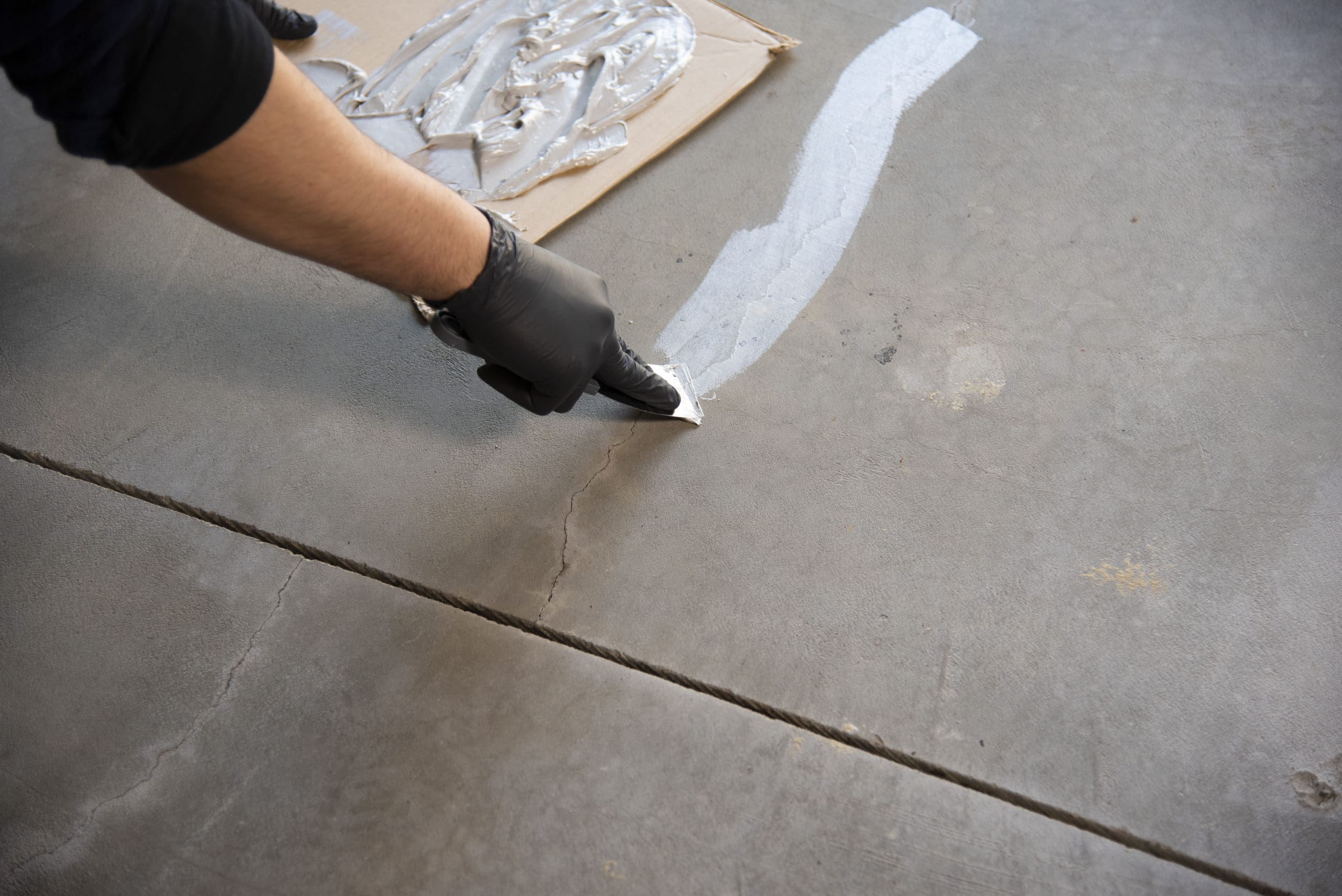
Between Florida's sandy soil, seasonal rain cycles, and tree roots, most concrete slabs in the Tampa area have some cracking — and that's not a disqualifier. It just means we deal with it first. We don't coat over cracks; we fix them so they don't show through later.
If there's significant cracking on your floor, we'll tell you during the free visit exactly what's needed, why it matters, and what it affects before anything is scheduled. No line items added on install day.
Hairline Cracks
Filled and feathered during standard prep — typically included at no additional cost.
Surface Cracks
Routed, cleaned, and filled with flexible polyurea filler before diamond grinding.
Structural Cracks
Assessed individually — may require epoxy injection or spall repair before coating.
Full Transparency
Repair scope and cost disclosed in writing before we schedule your install date.
No Pressure. No Surprises.
Just a Real, Written Price.
Four years in a row, Best of Tampa — and we think that comes from being straightforward. No surprises, no line items added on install day. Here's exactly what you get when you call us out.
Performance Floors & Coating
vs. Budget Competitors
These are the factors that separate a 10-year floor from one that starts failing in 18 months.
| What You Are Comparing | Performance Floors & Coating | Budget Competitors |
|---|---|---|
| Surface Preparation | Industrial diamond grinding — verified CSP-3 or greater | Acid wash only, or light grind — often CSP-1 or 2 |
| Moisture Testing | Every slab tested before any coating is applied | Rarely performed — leading cause of delamination |
| Coating System | Industrial-grade epoxy base coat + polyaspartic topcoat (Simiron Certified) | Water-based or low-solids consumer epoxy products |
| UV Resistance | UV-resistant polyaspartic topcoat — holds up in Florida's intense sun | Standard epoxies degrade under prolonged UV exposure outdoors |
| Crack Repair | Properly routed and filled before coating is applied | Covered over, not repaired — cracks telegraph through |
| Install Time | Completed in 1 day — walkable within hours | Often 2–3 days with extended recoat windows |
| Warranty | 15-year warranty against delamination | Verbal only — limited or no formal warranty provided |
| Best of Tampa Award | 4 Consecutive Years — Best Value in Tampa | — |
Common Questions From
Tampa Homeowners
Ready to Get Your
Real, Written Price?
Come out, see your floor, get a real written price. No pitch, no pressure, no number that changes when we show up to do the work.